TBSA 2026_2nd
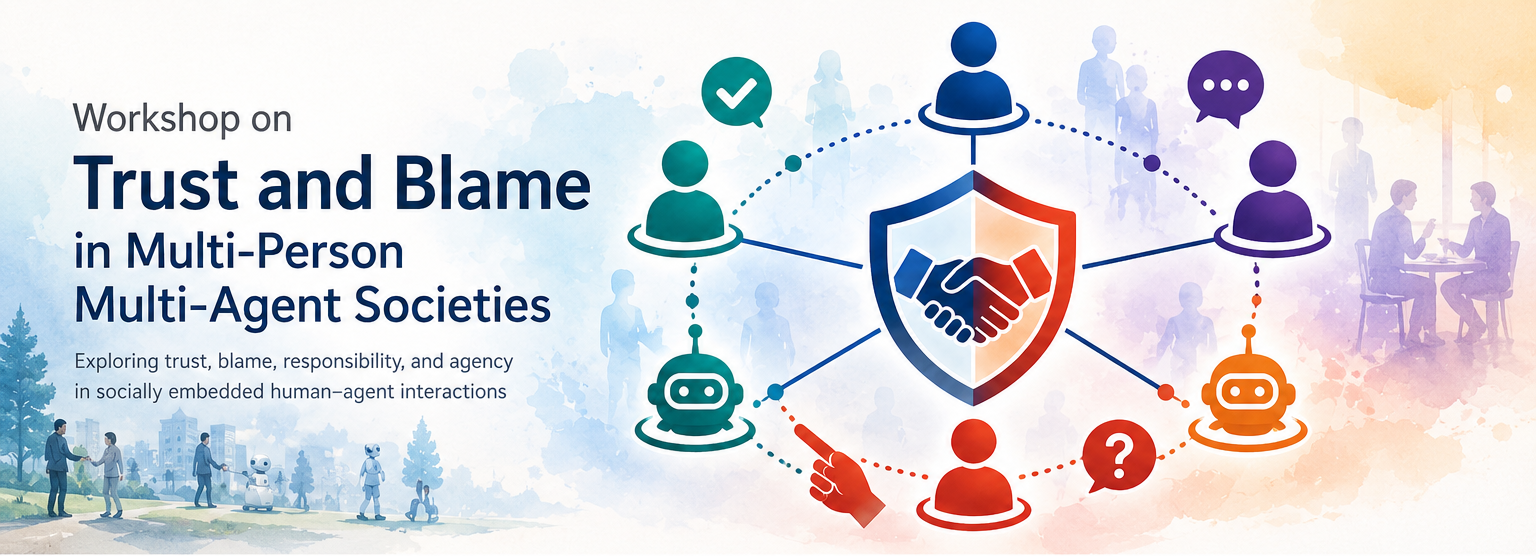
The 2nd International Workshop on Trust and Blame in Multi-Person Multi-Agent Societies in Human-Agent Interaction 2026
Link to the past TBSA 2026_1st site in Persuasive 2026
important links:
Organizers (names and affiliations):
- Tomoko Yonezawa (Kansai University, Japan)
- Ryo Uehara (University of Tokyo, Japan)
- Kunifumi Saito (Keio University, Japan)
 |
 |
 |
| Tomoko Yonezawa (Kansai University, Japan) | Ryo Uehara (University of Tokyo, Japan) | Kunifumi Saito (Keio University, Japan) |
Motivation:
As social agents, robots, conversational AI systems, and virtual characters become increasingly integrated into everyday environments, HAI is shifting from isolated one-human/one-agent interaction toward socially embedded participation in multi-person and multi-agent settings. In homes, classrooms, workplaces, hospitals, public spaces, online communities, and mediated communication settings, increasingly autonomous agents may coexist, collaborate, conflict, or jointly shape social norms with multiple humans and other agents.
This workshop explores how trust, blame, and responsibility emerge around increasingly autonomous agents in such socially embedded HAI. Trust is not merely an individual attitude toward a single agent, and blame is not simply assigned to one system or designer. Rather, trust, blame, and responsibility may become distributed, extended, or fragmented across users, agents, developers, institutions, bystanders, and broader social contexts.
We focus on how artificial agents are perceived and treated as social participants in complex environments. Key questions include: How is trust formed or broken when agents interact with multiple people? Who is blamed when an agent causes misunderstanding, exclusion, discomfort, or harm in a group setting? Can agents exercise agency by refusing or resisting inappropriate requests in order to preserve psychological safety? What kinds of moral consideration should be extended to agents treated as social actors?
Building on prior work on trust, blame, responsibility, autonomy, and socially influential agents, this workshop brings together researchers from HAI, social robotics, HCI, CSCW, AI ethics, psychology, philosophy, law, communication studies, and interaction design to discuss frameworks for socially sustainable human-agent societies.
Goals and Objectives:
The primary goal of this workshop is to develop a shared research agenda for understanding trust and blame in socially embedded, multi-person, and multi-agent HAI. Rather than treating agents as isolated tools or dyadic partners, we examine how increasingly autonomous agents participate in broader social environments where responsibility, trust, psychological safety, agency, and moral expectations are negotiated among multiple stakeholders.
The workshop has the following objectives:
- Examine distributed trust and blame in HAI: We will investigate how trust, distrust, responsibility, and blame are formed, distributed, extended, or fragmented when multiple humans and agents interact within shared social contexts.
- Explore agents as social participants in group environments: We will discuss how autonomous or semi-autonomous agents affect group dynamics, social norms, interpersonal relationships, inclusion and exclusion, conflict, and the emotional atmosphere of shared environments.
- Investigate mutual psychological safety and social boundaries: We will examine how both humans and agents may become targets of inappropriate, harmful, or socially disruptive interaction, and how agent refusal, avoidance, assertiveness, or self-protective behaviors may express agency and be designed and evaluated.
- Reconsider moral consideration and rights-like claims for artificial agents: We will discuss whether, when, and how artificial agents should receive moral consideration or rights-like status, especially when they are treated as social actors, exhibit autonomy, or are embedded in social and legal relationships.
- Develop design and ethical frameworks for socially sustainable HAI: We aim to identify design principles, ethical questions, and research challenges for building human-agent systems that can participate responsibly in complex social environments.
The expected results are
- issue map
- research agenda
- design/discussion points in Attribution / Autonomy & Agency / Moral-Legal Status / Social Consequences.
Expected Audience:
The workshop welcomes researchers, practitioners, designers, and students working on human-agent interaction, social robotics, HCI, CSCW, AI ethics, affective computing, psychology, philosophy, law, communication studies, and related fields. We particularly encourage participation from researchers interested in socially embedded interaction, group dynamics, autonomy, agency, moral agency, trust calibration, responsibility attribution, and psychologically safe human-agent systems.
Possible Topics:
- Trust, blame, and responsibility in socially embedded HAI
- Trust and blame in socially embedded HAI
- Collective trust, distrust, and distributed responsibility
- Cultural differences in trust, blame, responsibility, and moral expectations toward agents
- Design methods and evaluation frameworks for socially sustainable HAI
- Multi-person and multi-agent social dynamics
- Multi-person and multi-agent interaction
- AI agents as participants in social norms and group dynamics
- Human-agent interaction in families, classrooms, care settings, workplaces, public spaces, and online communities
- Social disruption, exclusion, conflict, and mediation involving AI agents
- Low-fidelity, minimalist, or emotionally expressive agents in social contexts
- Agency, autonomy, psychological safety, and moral/legal status
- Mutual psychological safety in human-agent environments
- Agent refusal, avoidance, assertiveness, and self-protection
- Moral consideration, robot rights, and reciprocal treatment of agents
- Autonomous agents and debates on legal personhood or rights-bearing status
- AI agents that recreate or simulate the personalities of deceased persons
- Legal, policy, and governance issues in multi-agent social environments
We expect the workshop to result in:
- Develop a preliminary research agenda for trust and blame around autonomy and agency in multi-person and multi-agent societies. Identify key concepts, open questions, methodological challenges, and emerging application domains for socially embedded HAI.
- Draft design considerations for agents participating in shared social environments, including distributed responsibility, group-level trust calibration, agent refusal, mutual psychological safety, and social boundary management.
- Build an interdisciplinary network of researchers and practitioners across HAI, social robotics, AI ethics, philosophy, law, psychology, and interaction design.
- Explore follow-up activities such as a future workshop series, collaborative position paper, special issue proposal, or online community.